

Solitaire Grand Harvest
Supertreat - A Playtika Studio
If you enjoy solitaire but want something a little more colorful and goal-driven than a plain card table, Solitaire Grand Harvest is an easy game to try. I found its basic idea immediately familiar: clear cards from a TriPeaks-style layout, make sensible choices, and keep moving through a cheerful farm setting. The presentation gives each short round a sense of place, while the card play remains simple enough for a first session.
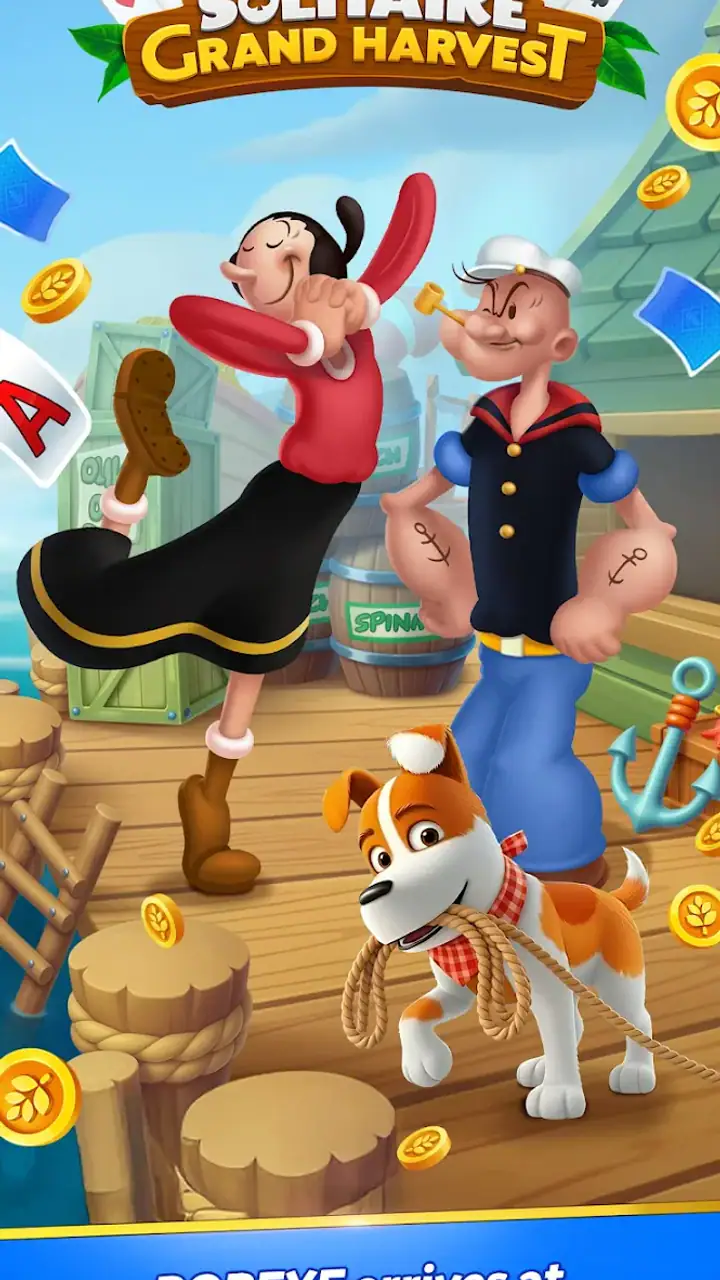
That simplicity is the main reason I can recommend it to casual players. You do not need to learn a complicated rule set before playing, and a round can fit into a spare moment while waiting for an appointment or taking a break. At the same time, it is not just a traditional solitaire clone. Progression, themed surroundings, and the appearance of Popeye at the Grand Farm give the game a more playful identity than a standard offline card app.
What to expect when you begin
This is a free card game from Supertreat - A Playtika Studio, aimed at an Everyone audience. It has attracted a 4.7 average from around 2.1 million ratings and has passed 50 million installs, which matches my impression that it is built for a broad audience rather than experienced card-game specialists. You can start without paying, although optional purchases range from $0.49 to $199.99 per item, so I would approach the shop carefully.
The central rhythm is straightforward. You look at the exposed card, compare it with the available card in your hand, and remove a card that is one rank above or below it when the layout allows. The objective is to uncover more of the board and keep the sequence going. That sounds simple, but the important decisions often come from choosing which exposed card to remove first rather than tapping the first legal move you see.
I like that the game makes solitaire feel active without turning it into a stressful competition. The farm theme softens the experience, and the card layouts give each attempt a small puzzle to solve. If your ideal game is a quiet, predictable deck with no extra decoration, this may feel busier than necessary. If you prefer a little atmosphere and a reason to continue after one hand, the setting works well.
Related News

Why WhatsApp Messenger Still Makes Everyday Communication Feel Easy

Jurassic World: The Game Is the Better Dino Tycoon for Strategic Players

Threads in Real Life: Who Should Join, Lurk, or Leave

How SHEIN Turned Shopping Into an Endless Content Feed

How to Make Fortnite Feel Smarter on Mobile

Should You Switch to Microsoft Outlook on Mobile?
It is worth understanding the difference between this and a conventional Klondike solitaire app before installing. Klondike usually asks you to build suits in a more formal way, while this game focuses on clearing a TriPeaks arrangement through short runs. A dedicated solitaire collection may offer more rule variations and less progression. This one is better suited to someone who wants one recognizable format presented as an ongoing casual journey.
The first setup should be simple
The game is available at no upfront cost, and the current version is 2.406.1. It supports devices running Android 7.0 or later. On a first launch, I would take a moment to look around the main screen before starting several rounds in a row. The useful habit is to identify where the current hand begins, where the available card is shown, and where any reward or purchase prompts appear.
That small pause matters because free-to-play card games often put several progress elements around the actual table. New players can mistake a decorative farm screen for the place where the next hand starts, or tap through a reward screen without noticing what has changed. I recommend reading each button once rather than rapidly accepting every prompt. It makes the opening feel less confusing and helps you keep control of the session.
Gallery
You also do not need to treat the first round as a test of skill. The early goal should be learning the relationship between the exposed cards and the card in your hand. Watch what happens after each removal, especially when a card underneath becomes available. Once that visual rhythm makes sense, the rest of the interface becomes much easier to read.
For a first-time player, the best setup is a short, uninterrupted session rather than trying to understand every farm element immediately. Play one hand, return to the surrounding screen, and then decide whether the progression interests you. The card table is the real test of whether this game suits you; the themed layer should support that experience, not determine it before you have played.
Your first meaningful success
A satisfying first success is not simply clearing one card. It is spotting a sequence that opens several cards without spending your useful options too quickly. Suppose the visible card allows you to remove a neighboring rank. Before tapping, scan the other exposed cards and ask which choice is likely to reveal another playable card. That one-second check is more valuable than playing at maximum speed.
My practical advice is to protect flexibility. If two cards can be removed, choose the one that uncovers more of the layout or leaves you with a better follow-up. A long run feels rewarding, but a long run that exposes the wrong section can leave the remaining board awkward. The game becomes more interesting once you stop treating every legal move as equally good.
Another useful habit is to slow down when several cards are available at once. Fast tapping is tempting because the rules are easy to understand, but it can hide the fact that the order of removal changes your options. I found the best early learning comes from deliberately examining the board after every reveal. That turns the first completed hand into a lesson rather than a lucky result.
When a round goes well, notice why it worked. Perhaps you cleared a central card that exposed multiple choices, or maintained a sequence long enough to remove a difficult group. Remembering that pattern helps more than memorizing individual card positions, because the layouts will not feel identical from one hand to the next.
This is also where the game separates itself from an automatic card puzzle. The rules are accessible, but there is still room for judgment. You cannot guarantee that every hand will unfold perfectly, and that uncertainty is part of the appeal. Players who want complete control may find unlucky layouts frustrating, while players who enjoy making the best decision from imperfect options will likely appreciate the tension.
Confusion that can slow down new players
The most common misunderstanding is expecting ordinary solitaire foundations. You are not mainly arranging complete suits from ace to king in the classic way. The immediate concern is the rank relationship between the current card and the exposed cards on the table. Once I viewed each hand as a chain-building puzzle, the interface made much more sense.
Another point of confusion is the difference between clearing the visible surface and actually exposing the hidden cards. Removing one card may look like a small action, but its real value is often the card it uncovers. When deciding between moves, I would prioritize the action that opens the most useful part of the layout, even if another move creates a slightly longer sequence right away.
Players may also wonder why a hand ends before every card is gone. That can happen when the available sequence no longer connects to any exposed card. It is not necessarily a mistake in tapping. The important response is to review the choices that led there, especially whether an earlier move used the only card that could have continued a later group.
The farm progression can create a second layer of uncertainty. It is easy to assume that every visual change directly improves your card chances, but I would keep the two ideas separate in your mind: the card hand is where your immediate decisions happen, while the broader setting gives those hands context and a reason to continue. This distinction helps prevent disappointment if you are looking for a pure strategy game with every element tied directly to solving the layout.
Optional purchases deserve similar caution. Because the game is free to start, the natural temptation is to use a paid item whenever a hand becomes inconvenient. I prefer to finish the session, consider whether the problem was a poor move or an unlucky layout, and only then decide whether spending adds value. The wide purchase range means the game can remain a no-cost pastime, but it also means you should set your own boundary before the shop becomes part of your decision-making.
How to build a better playing routine
For short sessions, I would use the game as a focused break rather than an endless background activity. Start a hand only when you have enough attention to inspect the layout. The rounds are approachable, but the best decisions still require a little concentration. Playing while distracted makes it easier to waste a useful sequence and then blame the layout.
A simple three-step routine works well for me. First, identify every currently exposed option. Second, choose the move that reveals the most promising next card rather than the move that merely looks fastest. Third, pause after each reveal and rescan the board. This is a small adjustment, but it turns random tapping into a repeatable method.
I would also avoid chasing a perfect streak at all costs. A long chain is exciting, yet preserving one available move can be more important than extending the current run by a single card. The trade-off is subtle: immediate progress feels good, but future access to the layout often matters more. That is one of the non-obvious lessons the game teaches once the introductory rules become familiar.
If you play regularly, use your early hands to learn how the layout communicates information. Look for cards that are blocking several others, and make them a priority when the sequence permits. This approach is more reliable than focusing only on the cards closest to the current one. The board is not just a collection of individual moves; it is a set of locked and unlocked opportunities.
A realistic everyday use case is a ten-minute evening break when you want something more engaging than scrolling but less demanding than a full strategy game. I can see it working particularly well for someone who likes familiar card rules, colorful presentation, and a gentle sense of progress. It is less suitable for a long commute without a stable connection or for anyone specifically seeking a completely stripped-down solitaire table; I would choose a traditional offline solitaire app in that situation.
Who will enjoy it, and who should skip it
I would point this game toward casual solitaire players, people returning to card games after a long break, and anyone who likes puzzle decisions wrapped in a light farm setting. The Everyone rating makes the basic presentation broadly approachable, and the familiar card relationships mean you can understand the first hand without studying a manual.
It is also a good fit if you enjoy games that give a small reason to come back after each round. The Popeye and Grand Farm theme adds personality, while the TriPeaks structure keeps the actual play recognizable. You do not need to be a competitive card expert to find useful choices, but you may still appreciate the difference between a careless move and a thoughtful one.
I would hesitate to recommend it to players who dislike any progression layer around solitaire. If you want several unrelated variants in one app, a traditional solitaire collection will probably offer more variety. If you want a completely quiet experience with no temptation to buy optional items, a simpler standalone card game may be a better match. The appeal here comes from the combination of cards, setting, and continued progression, so removing any one of those priorities changes the recommendation.
It may also frustrate people who expect every hand to be solvable through perfect planning. Card layouts can produce awkward situations, and good judgment does not eliminate uncertainty. I see that as a fair trade for the quick, replayable format, but it is important to know before you invest time in chasing every possible completion.
My next-step recommendation
After the first successful hand, I would not rush straight into purchases or try to master every surrounding feature. Play a few more rounds with one goal: improve the quality of your first move. Ask whether you uncovered a blocked section, preserved a useful option, or simply tapped the most obvious card. That reflection gives you a clearer sense of whether the game rewards the kind of thinking you enjoy.
Keep the free starting point in perspective. You can sample the core experience without committing money, and that is enough to decide whether the TriPeaks format and farm presentation hold your attention. If you continue, set a personal spending limit before optional items become part of the routine. I consider that especially important for a game whose short rounds make it easy to start “just one more” hand.
From a technical compatibility standpoint, the Android requirement is modest, with support beginning at version 7.0. The game is also available for iOS, so it is not limited to one mobile ecosystem. I would still check that your device has room for a modern game and that your preferred platform suits how you plan to play, but the stated Android threshold should cover many older supported phones.
My overall view is positive, with a clear qualification. Solitaire Grand Harvest is strongest when you want approachable card play with a colorful reason to keep going. It is not the best choice for a purist who wants only classic solitaire rules, nor for someone uncomfortable with optional purchases in a free game. For everyone else, it offers a friendly first step, enough decision-making to reward attention, and a more distinctive atmosphere than a bare card table.
After trying it, I would recommend starting slowly, learning to value revealed cards over quick taps, and treating the shop as optional rather than necessary. That approach lets the game’s best qualities stand out: short hands, readable rules, and small strategic choices that become more satisfying once you stop playing on autopilot. For a casual card break with a farm-themed sense of progress, it is a worthwhile free download to test for yourself.
FAQs for Solitaire Grand Harvest
What is Solitaire Grand Harvest?
Solitaire Grand Harvest is a popular card game app that combines the classic solitaire gameplay with farming elements. Players progress through levels by completing solitaire puzzles while also cultivating and managing their virtual farms. The game offers a unique twist on traditional solitaire, offering both card challenges and agricultural tasks.
Is Solitaire Grand Harvest free to play?
Yes, Solitaire Grand Harvest is free to download and play. However, it offers in-app purchases that allow players to buy coins and boosters, which can enhance gameplay and help progress through levels more quickly. While optional, these purchases can provide an advantage or additional features.
What are the main features of Solitaire Grand Harvest?
Solitaire Grand Harvest features a blend of solitaire card gameplay and farm-building elements. Players can enjoy hundreds of levels, daily rewards, and special seasonal events. The game also includes various card challenges and customization options for your farm, making it engaging for both solitaire enthusiasts and casual gamers.
Can I play Solitaire Grand Harvest offline?
No, Solitaire Grand Harvest requires an internet connection to play. This is necessary for accessing game features like daily rewards, events, and syncing progress across devices. Online connectivity ensures that players can enjoy the full experience, including leaderboards and social interactions with friends.
How does Solitaire Grand Harvest handle ads?
Solitaire Grand Harvest includes ads as part of its free-to-play model. However, players have the option to remove ads through in-app purchases. Watching ads can also offer benefits such as extra coins or boosters, providing players with a choice to engage with ads for added in-game advantages.
Pros
- Engaging daily challenges keep gameplay fresh.
- Beautiful graphics enhance the gaming experience.
- Offline mode available for uninterrupted play.
- Regular updates introduce new features and levels.
- Rewarding progression system with achievable goals.
Cons
- In-app purchases can be quite expensive.
- Energy system limits long play sessions.
- Ads can be intrusive during gameplay.
- Limited customization options for card decks.
- Some levels feel repetitive after a while.


